• Required reading for all forum users!!!

    Welcome!
    Register to access the full functionality of the GSResources forum. Until you register and activate your account you will not have full forum access, nor will you be able to post or reply to messages.

    A note to new registrants...
    All new forum registrations must be activated via email before you have full access to the forum.

    A Special Note about Email accounts!
    DO NOT SIGN UP USING hotmail, outlook, gmx, sbcglobal, att, bellsouth or email.com. They delete our forum signup emails.

    A note to old forum members...
    I receive numerous requests from people who can no longer log in because their accounts were deleted. As mentioned in the forum FAQ, user accounts are deleted if you haven't logged in for the past 6 months. If you can't log in, then create a new forum account. If you don't get an error message, then check your email account for an activation message. If you get a message stating that the email address is already in use, then your account still exists so follow the instructions in the forum FAQ for resetting your password.

    Have you forgotten your password or have a new email address? Then read the forum FAQ for details on how to reset it.

    Any email requests for "can't log in anymore" problems or "lost my password" problems will be deleted. Read the forum FAQ and follow the instructions there - that's what we have one for...

  • Returning Visitors

    If you are a returning visitor who never received your confirmation email, then odds are your email provider is blockinig emails from our server. The only thing that can be done to get around this is you will have to try creating another forum account using an email address from another domain.

    If you are a returning visitor to the forum and can't log in using your old forum name and password but used to be able to then chances are your account is deleted. Purges of the databases are done regularly. You will have to create a new forum account and you should be all set.

Cold inflate #s

Rob S.

Forum Guru
Past Site Supporter
I'd like a consensus, or opinions on, cold inflate numbers. I have Pirelli Sport Demons, 100/90-19 and 130/90-17, on the stock '82 'snowflake' wheels.

A while ago we were poking fun at the owner's manual "shift schedule" - up into 5th at 31 mph, down into 4th at 19 mph. Obviously silly. But someone said that their cold inflate numbers were just as absurd. Is that true (see photo)?
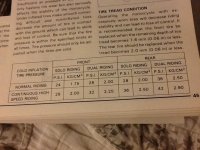
image.jpg

My mechanic said go by the manual or the tires. The tires only give max numbers. He returned the bike to me with 36 front, 30 rear. I left the rear at about 30 psi, but lowered the front to about 27.

I have the 10/20% formula, but it's not for me. I'm not concerned with getting the longest tire life, just the safest and stickiest ride. And while my rides frequently end with a run at the ton, they're short (10 - 20 miles in this weather), and I don't push things when I'm leaned over. I never carry a passenger.
 
I'm sure those numbers were fine for the tires of the time. I'd say it's probably a different story with modern rubber.

I know my bike handles like a tractor if I let the front get down to 28 psi. I like to run 32 psi front and 34-36 psi rear.
 
I was going to suggest the 10/20% formula until I saw this:
I have the 10/20% formula, but it's not for me. I'm not concerned with getting the longest tire life, just the safest and stickiest ride.
Too bad it's "not for you", because it really happens to work. It does give the safest and stickiest ride, and also the side benefit of best life.

I have never used Sport Demons on an 1100, so I can't give you the hard numbers you seem to want, but I would suggest using the 10/20% formula and starting with 30 psi at both ends. I only suggest starting at 30 because it's not a 'dangerous' pressure, and the math is easier for your first calculation.
 
It does depend on how you're riding. The usual percentage calculation applies on the street as a rule of thumb, but street tires on track work best 3 or 4 psi below what you would run on the street. High speed and cornering loads put a lot of heat into the tire, which would overpressurize the tire when hot. So you have to figure out your own cold temps. Find a good pressure when they're hot (in the target working conditions, on your particular bike, with your particular tire selection), then let them cool off and see where they are. The riding you describe isn't particularly stressful, so I don't expect you to settle on pressures that are much different from the percentage rule. Unless you're 400 lb, or mounted wrong size tires or something.
 
Last edited:
I was going to suggest the 10/20% formula until I saw this:

Too bad it's "not for you", because it really happens to work.

It's too complicated - I just want to ride.

I don't think my tires will get that hot on short, freezing weather trips.
 
Find a good pressure when they're hot...

???

What does that mean? I don't think I'm perceptive enough to notice a few pounds difference.

Assuming you all use the 10/20% rule, what are the cold numbers various people come up with?
 

Don't assume that others can do the home work for you...
Using numbers recommended by others which work for them will not likely work for you.
The best way to know your tire pressures is to check them (often) when riding.
Start a few pounds under the MAX COLD PSI number on the tire sidewall -
Once the tires are hot measure the pressure again and look for the 10% rise -
More than that the pressure is probably too low at cold.
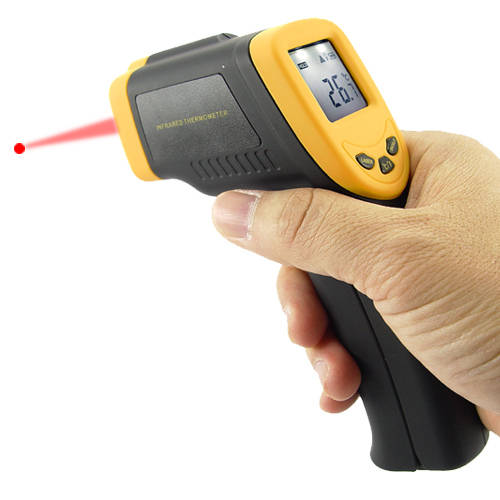
I own and use a temp gauge like this one- I follow my tire temps as a guide as well as the pressures
Non-Contact_Infrared_Thermometer_Temperature_Laser_Gun.jpg


For ME I use the MAX cold PSI from the sidewall on the tire down to minus 1-2 and it work great for ME .
My riding style is different, the bike is different, the roads are different, the loads are different.
I CHECK my pressures often and keep them static so I know what my rubber is doing on the road.
 
try this Pirelli pdf I found in a google search http://www.pirelli.com/mediaObject/pirellityre/gb/en/extra-catalogue/motorcycle/technical_data_book/PIRELLI_TDB2013_low/original/PIRELLI_TDB2013_low.pdf

but on page 214, in bold letters it does say follow the manufacturers recommendation...still, the preceding pages are a full chart of bikes they "have tires for", tires and recommended pressures

since you ask for a consensus, I will just toss in that I use The manufacturers' recommendation-Suzuki and whoever made the tyre are what I use, with maybe a variation a lb maybe .- short rides on rainy gravel versus hot rides on hwy...I might let air out to gain a bit of road surface but put it back for straight highway (and to get my tires' "crown" back up )
 
Last edited:
I've looked at quite a few old tires (usually on bikes I pick up for cheap) before disposing of them. The sidewalls on these tires from the '80s generally have MAX cold pressures in the low-mid 30s psig-wise. Newer tires that we buy (Roadriders, Sport Demons, Pilot-Activs, etc...) generally have MAX cold psig pressures about 10 psig higher than that.

Forget the original owner's manual recommendations. They're written for tires that we no longer use. Go by the 10% rule.

If you're too lazy to do that, enjoy crashing (again).
 
well... for the sake of argument, riding tires to the borderline of exploding doesn't have much to do with traction=(tire surface on the road).
Plus, Pirelli includes several of our bikes in the pdf above. It's not as though they haven't thought about it. Likewise, Avon and many other manufacturers know we're "out here". They all pretty much say to use the manufacturers recommended. Where they differ, I'd expect them to mention it.

Harder tires are a harder ride with less contact to the road .They will run cooler therefore. On the other hand, If your tires' pressure is increasing more than 10% hot it indicates they are underinflated. Mine with the manuals recommends are not underinflated according to this rule.

The 10% rule is a LIMIT of pressure change and is an indication tires are running hot. It's not a goal.

Here's a more specific opinion....

The manufacturers recommended pressures are therefore the best compromise as they have no idea of the type of riding you do, the type of roads you travel on and the climatic extremes of where you live. You as a rider can therefore adopt their approach - stick rigidly to the recommended pressures and forget about the matter altogether. This approach is a good one for motorcyclists who travel short distances and long distances on asphalt only in a country with a moderate climate.

as to conditions of load, terrain and temperature where you are
maybe you can do this
NOTE: The table below is not for specialist tyres that require very specific tyre pressures to perform. At no times should the maximum type pressure be exceeded as per the manufacturers specification​
[TABLE="width: 95%"]
[TR]
[TD="width: 30%, bgcolor: #FFCC66, align: center"]Tyre Pressure[/TD]
[TD="width: 70%, bgcolor: #FFCC66, align: center"]Conditions[/TD]
[/TR]
[TR]
[TD="width: 30%"]40% above recommended[/TD]
[TD="width: 70%"]High speed, long distance touring in warm weather with a loaded bike in all round ideal conditions[/TD]
[/TR]
[TR]
[TD="width: 30%"]30% above recommended[/TD]
[TD="width: 70%"]High speed, long distance touring in warm weather in all round ideal conditions[/TD]
[/TR]
[TR]
[TD="width: 30%"]30% above recommended[/TD]
[TD="width: 70%"]Asphalt surface but with large, dangerous potholes and other sharp surface hazards[/TD]
[/TR]
[TR]
[TD="width: 30%"]20% above recommended[/TD]
[TD="width: 70%"]Long distance commuting including highway / freeway travel[/TD]
[/TR]
[TR]
[TD="width: 30%"]Manufacturer's recommendation[/TD]
[TD="width: 70%"]Short distance commuting in city traffic below 100kph. Seasons Spring, Summer and Autumn[/TD]
[/TR]
[TR]
[TD="width: 30%"]Manufacturer's recommendation[/TD]
[TD="width: 70%"]Off road trail with smaller rocks at some speed[/TD]
[/TR]
[TR]
[TD="width: 30%"]Manufacturer's recommendation[/TD]
[TD="width: 70%"]Riding when conditions are less than ideal e.g. in very windy conditions. Or when conditions vary a lot.[/TD]
[/TR]
[TR]
[TD="width: 30%"]10% below recommended[/TD]
[TD="width: 70%"]Riding when conditions are less than ideal for shorter distances at moderate speed e.g. in extremely windy conditions[/TD]
[/TR]
[TR]
[TD="width: 30%"]15% below recommended[/TD]
[TD="width: 70%"]Short distance commuting in city traffic below 100kph during cold Winters[/TD]
[/TR]
[TR]
[TD="width: 30%"]15% below recommended[/TD]
[TD="width: 70%"]A long day of riding in the wet at moderate speed[/TD]
[/TR]
[TR]
[TD="width: 30%"]15% below recommended[/TD]
[TD="width: 70%"]Dirt road with moderately good surface but with some rocky spots[/TD]
[/TR]
[TR]
[TD="width: 30%"]40% below recommended[/TD]
[TD="width: 70%"]Travelling slowly in loose, deep sand with tyres with tubeless tyres[/TD]
[/TR]
[TR]
[TD="width: 30%"]40% below[/TD]
[TD="width: 70%"]Rocky off road trail with very uneven surfaces at slow speed[/TD]
[/TR]
[TR]
[TD="width: 30%"]50% below recommended[/TD]
[TD="width: 70%"]Travelling slowly in loose sand with tyres with tubes. Tyres must not get too hot.[/TD]
[/TR]
[TR]
[TD="width: 30%"]60% below recommended[/TD]
[TD="width: 70%"]Travelling slowly in very loose, deep sand with tyres with tubes. Tyres must not get too hot. Tyres must not be able to slip on the wheel rims[/TD]
[/TR]
[/TABLE]

I'd say none of the above applies where you get near the manufacturers' MAXIMUM pressure on the sidewall . Seems like a person will need a pump on their bike to follow it
 
Last edited:
Go by the 10% rule.

If you're too lazy to do that, enjoy crashing (again).

I'll try and explain this:

From the 10% rule:

"First check the tire pressure when the tire is cold. Then take a ride on your favorite twisty piece of road."

This is NY City. There is no "twisty piece of road" to warm the tires up on.

I take short rides.

"Then, measure the tire pressure immediately after stopping."

Frequently, I take an expressway home after a street ride, and get her up to about 90 mph on the final stretch. I suppose I could risk my life, pull over, get out a gauge and flashlight and take some readings.

"If the pressure has risen less than 10% on the
front or 20% on the rear, the rider should remove air from the tire."

So is the goal to have the pressure raise 10% (front), or more than 10%?
 
I think that Pirelli info is good and can be used by us non-racer types.

They suggest between 2.0-2.2 bar front (29-32 psi), and 2.5 bar (36 psi) rear. This jives with what I've seen from other tire manufacturers too.
 
I used the 10% rule back in my silly days. Actually worked out then to be about an 8% rule then when street riding. For the average rider that is not a real good way to set the air in your tires unless you really know what you're doing. There are too many variables to contend with, hot day, cold day, fast ride, slow ride, aggressive ride or non aggressive. They all play a part in your tires temperature and thus the percentage rise and max tires pressure. Go with the tires charts because the info in the owners manual is just too old. A temp gauge could be good if you know what an ideal temperature should be, but then again, too many variables in riding. On my 1000 I ended up running 32 front and 36 rear and yes I do check for the 10% but only on a warm day after a long aggressive ride and then recheck the cold temp the next morning and use that as a base line setting. Best advice is check them often when cold and get used to how your tires feel when riding and to the touch because the quickest way to do a quick check is with your hand. For street riding if it's uncomfortable to keep your hand on the tire it's too hot.
 
Back
Top