• Required reading for all forum users!!!

    Welcome!
    Register to access the full functionality of the GSResources forum. Until you register and activate your account you will not have full forum access, nor will you be able to post or reply to messages.

    A note to new registrants...
    All new forum registrations must be activated via email before you have full access to the forum.

    A Special Note about Email accounts!
    DO NOT SIGN UP USING hotmail, outlook, gmx, sbcglobal, att, bellsouth or email.com. They delete our forum signup emails.

    A note to old forum members...
    I receive numerous requests from people who can no longer log in because their accounts were deleted. As mentioned in the forum FAQ, user accounts are deleted if you haven't logged in for the past 6 months. If you can't log in, then create a new forum account. If you don't get an error message, then check your email account for an activation message. If you get a message stating that the email address is already in use, then your account still exists so follow the instructions in the forum FAQ for resetting your password.

    Have you forgotten your password or have a new email address? Then read the forum FAQ for details on how to reset it.

    Any email requests for "can't log in anymore" problems or "lost my password" problems will be deleted. Read the forum FAQ and follow the instructions there - that's what we have one for...

  • Returning Visitors

    If you are a returning visitor who never received your confirmation email, then odds are your email provider is blockinig emails from our server. The only thing that can be done to get around this is you will have to try creating another forum account using an email address from another domain.

    If you are a returning visitor to the forum and can't log in using your old forum name and password but used to be able to then chances are your account is deleted. Purges of the databases are done regularly. You will have to create a new forum account and you should be all set.

Plugged tire experinces and stories

  • Thread starter Thread starter GS750GUY
  • Start date Start date
G

GS750GUY

Guest
I'm interested in hearing your stories and experiences regarding running a plugged rear tire after experincing a flat. I know that front tires present a whole nother concern so for simplicity sake I'm wanting to limit this discussion to the rear tire only.

The reason I ask is because during my pre-ride inspection this morning I found a small sheet metal screw in the face of my rear tire, a Dunlop 402 with only less than 2000 easy miles on it. The screw was through the thick part of contact face of the tire and not in the bottom of the tread channel.
Since it was a very small screw and I always ride very conservativly anyway (never over 55 MPH) I plan to have the tire properly repaired at a shop and plan to continue to use it.

Just for the heck of it I went online to read what other bikers have experienced using rear tires that had only been repaired by using the plugging method of repair and I was amazed at what I read. So I was curious what kind of stories I would receive from the GS family of riders.
The online stories I read ran the gammut of opinion saying to definitely replace the rear tire to one guy that claimed he used a plugged tire on the back of his bike that regularly experienced 140 MPH track days and wheelies and had not one problem with the plugged rear tire.
So I just thought it would be fun to hear from the GS members regarding your experiences and stories about plugged rear tires.

GS750GUY
 
OK, I have plugged both tires, but will only tell you about the rear. :D

On the way home from Nebraska to oHIo, stopped at a DQ for some ice cream. Came out to find the bike standing up a bit straighter, due to a flat rear tire. Wrestled the bike (Kawasaki Voyager 1300) onto the center stand with help from my brother-in-law, found the offending screw and removed it after marking the location. Dug into the saddlebag, retrieved the plug kit. After carefully applying a small amount of adhesive to the 'sticky rope' plug, I wrestled with it until it was beyond recognition and still outside the tire.
cus.gif
In desperation, I gooped up another 'sticky rope' with liberal amounts of adhesive and tried again. To my amazement, it slid right in. :dancing: We used a small 12-volt compressor to get some air into the tire so I could ride down the block to the gas station and fill it with a good hose. I was a bit leary about using so much adhesive, but it set up real quick and never leaked for the rest of the time I had the bike.

I do believe that plug was still in there when I sold the bike about 8,000 miles later, but it was not alone. I had installed another plug, knowing I was getting rid of the bike, then there is also the one in the front tire that I am not telling you about.

The bike was a HEAVY bike, I had it on the scale once at 980 lbs. That's just the bike and the registration papers, nothing else. I would occasionally ride two-up, and also tow a trailer. Highway speeds were generally kept to 70 or below. Cornering is not overly aggressive, but the floorboards were known to touch down with some regularity.

.
 
I've used plugs for years & years. Bikes, cars, Road tractors, everything. Once a plug started leaking, on a car tire, weeks after it was installed, & I needed to put another plug in with the orig plug, then all was well. A plug fills the hole with new rubber, a patch covers the hole with a very thin layer of rubber, a patch plug is best, it puts a patch on the inside plus fills the hole with new rubber. Stories will vary greatly from never use a plug to I wouldn't use anything else. My opinion it's kind of like cast bike wheels, not marked "tubeless", not holding air without a tube. I've used plugs forever with no problems and used tubeless tires on cast wheels, not marked "tubeless" with no problems. But others have had plug problems every time they have tried them & their tubeless tires have leaked everytime if the cast wheel didn't have "tubeless" engraved on them. Just my opinion
 
Im posting this for a guy I know.:rolleyes:

Picked up a machine screw in the rear K491. Installed a tube. Kept on going. The tire has a mfg date of 086. :eek:
 
while not specifically about plugged bike tires, I work in a shop that does tire repairs. I've repaired (using internal plug-patch) dozens of plugged car tires that leaked and come across 3 plugs that weren't leaking (all by the same guy). BUT think about it... people are only gonna want it fixed are those that it's leaking. I'm not gonna hear about the ones that don't leak.

-IMHO plugs are good to get you to a shop.
-If you're good at doing them or lucky, they can last forever.
-best is patch/plugs. they will outlast the rest of the tire.
 
I've used plugs for years & years. Bikes, cars, Road tractors, everything. Once a plug started leaking, on a car tire, weeks after it was installed, & I needed to put another plug in with the orig plug, then all was well. A plug fills the hole with new rubber, a patch covers the hole with a very thin layer of rubber, a patch plug is best, it puts a patch on the inside plus fills the hole with new rubber. Stories will vary greatly from never use a plug to I wouldn't use anything else. My opinion it's kind of like cast bike wheels, not marked "tubeless", not holding air without a tube. I've used plugs forever with no problems and used tubeless tires on cast wheels, not marked "tubeless" with no problems. But others have had plug problems every time they have tried them & their tubeless tires have leaked everytime if the cast wheel didn't have "tubeless" engraved on them. Just my opinion

Many of the online comments regarding this topic said the same that they have used plugged tires on motorcycles for years and when the old tire wore out the plug was still there doing it's job.
I am presently using tubless tires on my cast wheels that are not marked "tubeless" and having no problems at all. In fact, during winter storage I will loose only two or three pounds of air pressure.

Back to the plugged tire topic.......It's amazing the wide range of opinion on the subject.
If you like we can open this up to plugged front and rear tires to make it more interesting. I guess I just assumed that because of safety reasons that no one out there would be running plugs or possibly even patched and plugged tires on the front end.
I'm basing this comment on what all the manuals and experts say. And of course those that sell tires.

GS750Guy
 
I've used some plugs, never had one fail.
Maybe a slow leak here or there.
Big deal.
But I guess some folks are afraid of flat tires.
 
Last edited:
I currently have a plug in my rear tire If done properly it's fine. Like said you need to use lots of adhesive, it helps the plug slide in...
 
I guess I just assumed that because of safety reasons that no one out there would be running plugs or possibly even patched and plugged tires on the front end.
Would that be because a failure on the front would be any worse than a failure on the rear? :-k

I don't think so. I totalled a bike back in 1983 due to a blow-out on the rear tire.
Yeah, there were other contributing factors, but the bottom line is, we lost a bike due to failure of the rear tire.

I have never had a catastrophic failure on a front tire for comparison, but I did have a quick leak (tire went flat in about 5 minutes) in one. Fortunately, I was running some Goodyear GTII tires with their patented Safety Bead tires that locked down over the rims in the case of deflation. Kinda squishy riding to get to the station for air, but I got there OK.

.
 
I've plugged motorcycle tires a few times with the "sticky string" plugs, with excellent results.

When removing the tires after they were worn out, the sticky string inside the tire had formed a tight little hemisphere over the puncture, and the repair was nearly impossible to pull out from the inside -- I had to get a BIG pair of pliers and pull HARD.

The sticky string plugs really do work very well on tubeless tires. If it's a simple puncture, I have no qualms about riding on a plugged tire. If the item that punctured the tire caused more damage than just a simple hole, or made a very large hole, then of course it's time for a new tire.


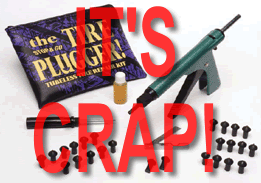
I also want to be very clear that there is a style of tire plug sold to motorcyclists that does NOT work. Plain and simple, these things are 100% useless junk, yet you'll find them touted in every catalog and most shops as if they are actually capable of retaining air.

DO NOT BUY ==> http://www.stopngo.com/motorcycle.asp <== USELESS CRAP

< fraud >
tire_plugger.gif

< /fraud >

I'm talking about the "Stop-n-Go" tire plugs. They look great in theory, but the plugs work themselves out very quickly in a motorcycle tire. I have gotten them to work in car tires maybe 50% of the time, but they are simply not at all suitable for use on motorcycles. Don't get suckered like I did. :mad:

Also, FYI, it's a lot more useful to carry a small air compressor than the CO2 cartridges. If you have a really bad puncture or your tire plugging system turns out to be a fraud (cough :rolleyes: ) you can easily run out of cartridges in a remote location. With a compressor, you've got an unlimited supply of air and a much better shot at limping back to civilization.

I carry a "Slime" brand pump -- it's inexpensive, available almost everywhere, and is the most compact pump I've seen.
 
Last edited:
I've been wondering if I should buy a plug kit and air pump.
We're getting ready for our (my first) out-of-state ride so we're putting together the check list...
Could you please post the URL of the tire plug kit you recommend and that "slime" pump? Thanks.
 
I work in a tire bay. If the tire is repaired via RMA standards then it will be fine. If you do anything other than RMA standards the results are not always 100%. RMA standards involve a silicon/rubber plug and a patch on the inside of the tire. To use the patch you buff down the inner liner and apply a special cement that Vulcanizes with the patch to create an air tight seal. After doing hundreds of patches that way I have never had someone come back. Also, you should only repair if the hole is in the centerish of the tire, if you do it to close to the sidewall that patch could fail.


Also, I have seen people talking about slime. Slime is probably one of the worst things to use in tires. It is ment as a temporary fix until the tire can be properly repaired, which should be done immediately. If you leave Slime in the tire to long it starts to eat away at the inner liner and you can actually start to lose air through the actual tread area. The reason is because rubber is naturally pourous and by itself will leak air over a period of time. Tire companies line the inside of the tire with silicon to seal the rubber.
 
Last edited:
Agreed -- Slime, the green goo that's supposed to go inside your tire, is actually fairly useless and creates a big mess for the next person who removes the tire. Please don't use it in motorcycle tires. Maybe in your lawn tractor.

However, the same company markets a lovely little air pump right next to the bottles of green goo. It's a little sliver painted widget about half the size of a hardcover book.

The Slime brand pump is available literally everywhere -- Wal-Mart, Meijer, Target, Pep Boys, AutoZone, etc. I got mine at Meijer on sale for $20.


I've used the patches that install from the inside, but they're getting VERY hard to find these days. The last one I installed was a rather low-quality example sold by Monkey Grip, and although it didn't leak, when I changed the tire I found that it had peeled loose from the inside. Probably more my fault for inadequate surface prep.

I checked farm stores and every auto store I could find, and these types of patches are simply not sold any more (found one dusty package at Pep Boys). I couldn't find a good source for them online unless I wanted to buy several dozen.

If anyone knows a good inline source for quality tire patching supplies, like Camel brand or better, I'm all ears.
 
Last edited:
If the tire is 50% or greater worn, I replace it. I've yet to 'whole' a new tire but in the event I did, I would break it down and have a patch done on the inside of the tire to prevent debris from getting in and then tube it. Plugs do work...but I'm the 1% that they seem to fail on. Cars, yes. Lawn tractors yes. Bikes, not so much.

Just my thoughts...
 
Would that be because a failure on the front would be any worse than a failure on the rear? :-k

.

I'm often wrong.......but I thought I read somewhere that a blowout on the front at highway speeds is less controlable and potentially more disasterous than a blowout on the rear. :o
GS750GUY
 
I like to use these, if the tire is relatively new. I use a plug kit
to get me home. Once home, the tire comes off and a Plug-Patch
is installed from the inside. I've probably used 7 or 8 of these over
the last 10 years and have never had one fail, Used with volcanizing
cement, it actually does become part of the tire. Recently ran a tire
repaired with one of these on the Blackbird for 4K miles.

Patch-N-Plug is one of the best repairs for nail hole injuries in the crown or sidewall, including speed rated radial tires. Cord reinforced radial and conventional all-rubber units are offered. Directions: Drill out injury hole, then cement the repair on the inside of the tire and push through the hole. Using pliers, pull the quill until the repair unit seats. Stitch the patch-N-Plug down from the inside and cut off excess plug rubber so that it will flush with the crown or sidewall.
 
Back
Top