• Required reading for all forum users!!!

    Welcome!
    Register to access the full functionality of the GSResources forum. Until you register and activate your account you will not have full forum access, nor will you be able to post or reply to messages.

    A note to new registrants...
    All new forum registrations must be activated via email before you have full access to the forum.

    A Special Note about Email accounts!
    DO NOT SIGN UP USING hotmail, outlook, gmx, sbcglobal, att, bellsouth or email.com. They delete our forum signup emails.

    A note to old forum members...
    I receive numerous requests from people who can no longer log in because their accounts were deleted. As mentioned in the forum FAQ, user accounts are deleted if you haven't logged in for the past 6 months. If you can't log in, then create a new forum account. If you don't get an error message, then check your email account for an activation message. If you get a message stating that the email address is already in use, then your account still exists so follow the instructions in the forum FAQ for resetting your password.

    Have you forgotten your password or have a new email address? Then read the forum FAQ for details on how to reset it.

    Any email requests for "can't log in anymore" problems or "lost my password" problems will be deleted. Read the forum FAQ and follow the instructions there - that's what we have one for...

  • Returning Visitors

    If you are a returning visitor who never received your confirmation email, then odds are your email provider is blockinig emails from our server. The only thing that can be done to get around this is you will have to try creating another forum account using an email address from another domain.

    If you are a returning visitor to the forum and can't log in using your old forum name and password but used to be able to then chances are your account is deleted. Purges of the databases are done regularly. You will have to create a new forum account and you should be all set.

Twinpot Brake upgrade on 78 Skunk

True, but I'd like to research the idea just to keep the looks symmetrical....think how a cycle would look with different front and rear rims - that's my thought line on it.
 
Haha - I've done that too... In the year plus that I ran these wheels not one person noticed. :)

P1000073.jpg
 
Very nice! It should be possible to fit one of the Honda front rotors to the rear which would match up the look as the PCD is the same on both front & rear Suzuki wheels from memory.

this would definitely save on weight! Using the GS caliper would probably require removing some of the brake pad friction material towards the inside using a Dremel, as I believe, don't quote me, that the friction surface is taller on the GS rotor. you would then have some very touchy rear brakes! using the stock GS pad as I said would help with making it not lock up as prematurely.

I upgraded the rear on mine just to drop weight and ditch the 295 rotor.I was told the caliper used on the GS 650 rear and other models, cross reference it, is slightly lighter than the caliper that came on my bike, GS1100's and 1000's, and others. I went with a newer hanger for the 275 rotor, a GS1150 caliper which requires extensive brake stay modification, and something along the lines of a front right 1989 through 1991 1100 katana floating rotor with the correct 22.5mm offset and 275mm diameter. this used the same bolt circle diameter, but the bolt holes ended up being 10 mm, so I had to redrill the pattern a half hole off with 8mm holes. this style of rotor is harder to come by, but substantially lighter than the GS set up.

upgrading to a caliper with a longer swept area on the brake pad would be much more beneficial, as that is what is really outdated on our stock brakes. The longer the pads, the better the stopping. A taller pad with the same surface area as a longer skinny pad will not grip as well as the long skinny pad on similar diameter rotors. The long skinny pad has more leverage because it is gripping at the outer part of the rotor entirely, where the diameter & leverage force advantage is greater, instead of half of the surface area of the pad gripping in a smaller rotor diameter area more toward the inside.
 
so far when I stopped researching it, 275 was the smallest diameter I could find in a 6 bolt rotor with a similar PCD. I would be thrilled to find a slightly smaller diameter floating rotor that was easily adaptable to our hubs, then we could make caliper bracket adapters or new brake caliper hanger bracket to fit the proper modern calipers to match the rotor, with longer swept area.
 
...upgrading to a caliper with a longer swept area on the brake pad would be much more beneficial, as that is what is really outdated on our stock brakes. The longer the pads, the better the stopping. A taller pad with the same surface area as a longer skinny pad will not grip as well as the long skinny pad on similar diameter rotors. The long skinny pad has more leverage because it is gripping at the outer part of the rotor entirely, where the diameter & leverage force advantage is greater, instead of half of the surface area of the pad gripping in a smaller rotor diameter area more toward the inside.

So, even if the surface area of both designs is the same...square inch wise...the stopping power is greater with the elongated pads verses the circle style? Ya lost me in the applied psychics.... but I do have to agree that the circle style brake pad isn't really used anymore....might be a reason for that.
 
So, even if the surface area of both designs is the same...square inch wise...the stopping power is greater with the elongated pads verses the circle style? Ya lost me in the applied psychics.... but I do have to agree that the circle style brake pad isn't really used anymore....might be a reason for that.

yes, correct. all of the surface area of the elongated pads is working on the larger effective rotor diameter area, whereas the round pads, half of the pad is effectively working on a much smaller diameter rotor, therefore has the effect of a much smaller diameter brake. factor in on top of that upgrading the front from 275 duals up to 296 duals, and it is very easy to see why this is a substantial braking upgrade!
 
Haha - I've done that too... In the year plus that I ran these wheels not one person noticed. :)

P1000073.jpg

I had one large diameter front brake and one small one for a year, and one was solid one was drilled. Can't even remember what was on the rear.
No one notices things like that unless your in a bike show or something.
 
Chuck78- that does make sense!

tkent02- {chuckle}we must be different here then, we always scrutinize each others cycles...looks/speed/mods.....
 
I used Honda GL 1500 Valkyrie rotors for mine (1997-2003). They are nice because the bolt pattern is the same as stock, just need to enlarge holes to 8mm. They are a 296mm rotor. Also, the inner part of the rotors are Aluminum, so they drill very easily. They are a little different look than the CBR rotors, I like 'em. All clearances were fine with Salty's kit.

 
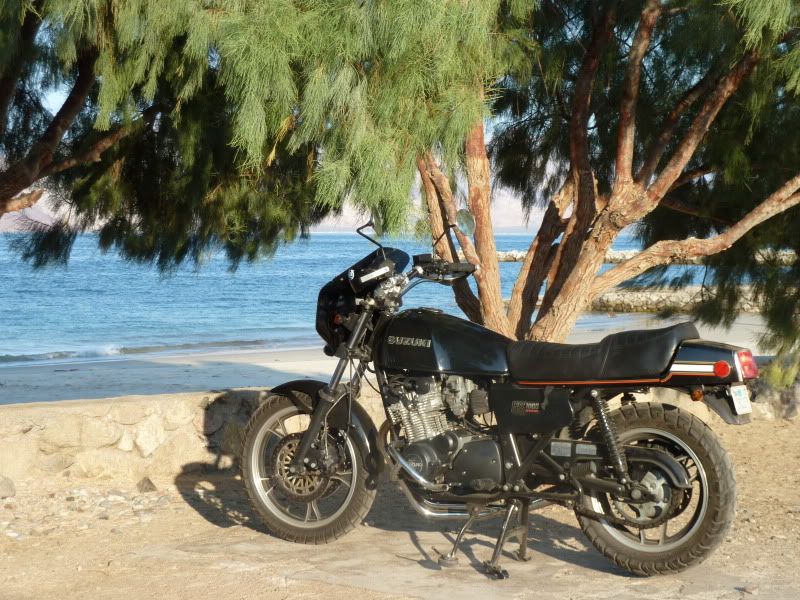
Full shot for you Steve. I'll try to replace it with a better one when I get a chance.
 
Last edited:
Thanks, I wasn't sure how they would look but I think they gave it some class!
 
A bit more traditional looking than the CBR ones. A good option to have :)
 
I gotta ask...what's the braking difference between the different sized twin pot calipers that everyone is using and the matched hole calipers?
Salty knows where this is going....along the way of procuring parts for my twin pot upgrade, my 07 Kawi EX650 MC came with it's matching calipers - which happen to be the same sized hole type. I'm told those aren't the ones of choice.....I get that....but it's my usual curiosity that makes me ask why this is?...why is the big and lil holed version so much better?
 
what's the braking difference between the different sized twin pot calipers that everyone is using and the matched hole calipers?

my 07 Kawi EX650 MC came with it's matching calipers - which happen to be the same sized hole type. I'm told those aren't the ones of choice.

but it's my usual curiosity that makes me ask why this is?...why is the big and lil holed version so much better?

is that a typo and you meant master cylinder bores?if your caliper setup does not properly match your master cylinder, you will have either a very spongy lever feel since you need to be moving twice as much fluid as you are, or a very hard lever feel.

EDIT - Ahhh I see... your wording and terminology were confusing. I looked up those calipers. That year has similar calipers to the ones we use, but non-universal L and seperate R caliper brackets without the matching holes on top and bottom on the universal L or R brackets

Also, more likely what you are referring to is that both of the pistons are the larger diameter, unlike the ones with the "universal L &/or R" bracket that have a smaller piston and a larger piston in each caliper. The pads look nearly the same. That would be excellent if those calipers would also work with dan's brackets as well. They appear to have a steel bracket still, so they could also be chopped up and welded onto as I did on mine.

I am guessing that with a smaller&larger piston, you may get a little bit of brake shoe toe-in to avoid squeal/noise, but causing a little more uneven pad wear. with a larger piston pair in each caliper, I am speculating that if the master cylinder bore is the same as with the older style, then you will get more power out of the caliper but a softer lever feel with more lever travel needed to reach full braking. basically you would have easier effort on the lever, but more travel of the lever needed. So you would have more powerful brakes, but your lever would come back further. I suppose they could change the geometry of the lever and the leverage it exerts to alter that as well. Lots of variables here.
 
Last edited:
Chuck, No, what I'm talking about is the 2 different types of twin pot calipers- the ones folks here are using, are the big and small piston version - while the other type is the matched sized piston twin pots. Lacking a pick Id say the one type in question would be the oem matched sized piston, twin pot calipers of an 07 Kawi EX650A7f.
Using CrazyClouds last posted pick- that type of twin pot caliper has the big piston hole on top and a lil one on the bottom- twin pot, but two different sized pistons.....the ones on an 07 Kawi EX650A7f have both pistons the same size....hope that helps explain my end of it.

Edit- yeah, sometimes it's hard to convey things from my head to the web...or others. Wasn't trying to talk down to you or anything.
 
Last edited:
"Feel" at the lever and less likely to squeal. The pads tend to wear even regardless in my experience. I believe the main reason they probably changed is for cost reasons. Less material & less SKU's, less material in the pad & a slightly easier pad swap (which helps dealer margins). They have one less piston & one less size O ring to stock.

I have ridden a couple of bikes with those later brakes fitted. Similar in every way. The bracket does not suit our purposes as well & they don't work with that bracket. Eventually I will look at them as an alternative when it becomes impossible to get good calipers but haven't had a chance as yet other than to have a quick look and see that it will be a 4 bolt bracket & will be more complex than what we currently have. (Read MORE EXPENSIVE :D )

:)
 
Back
Top