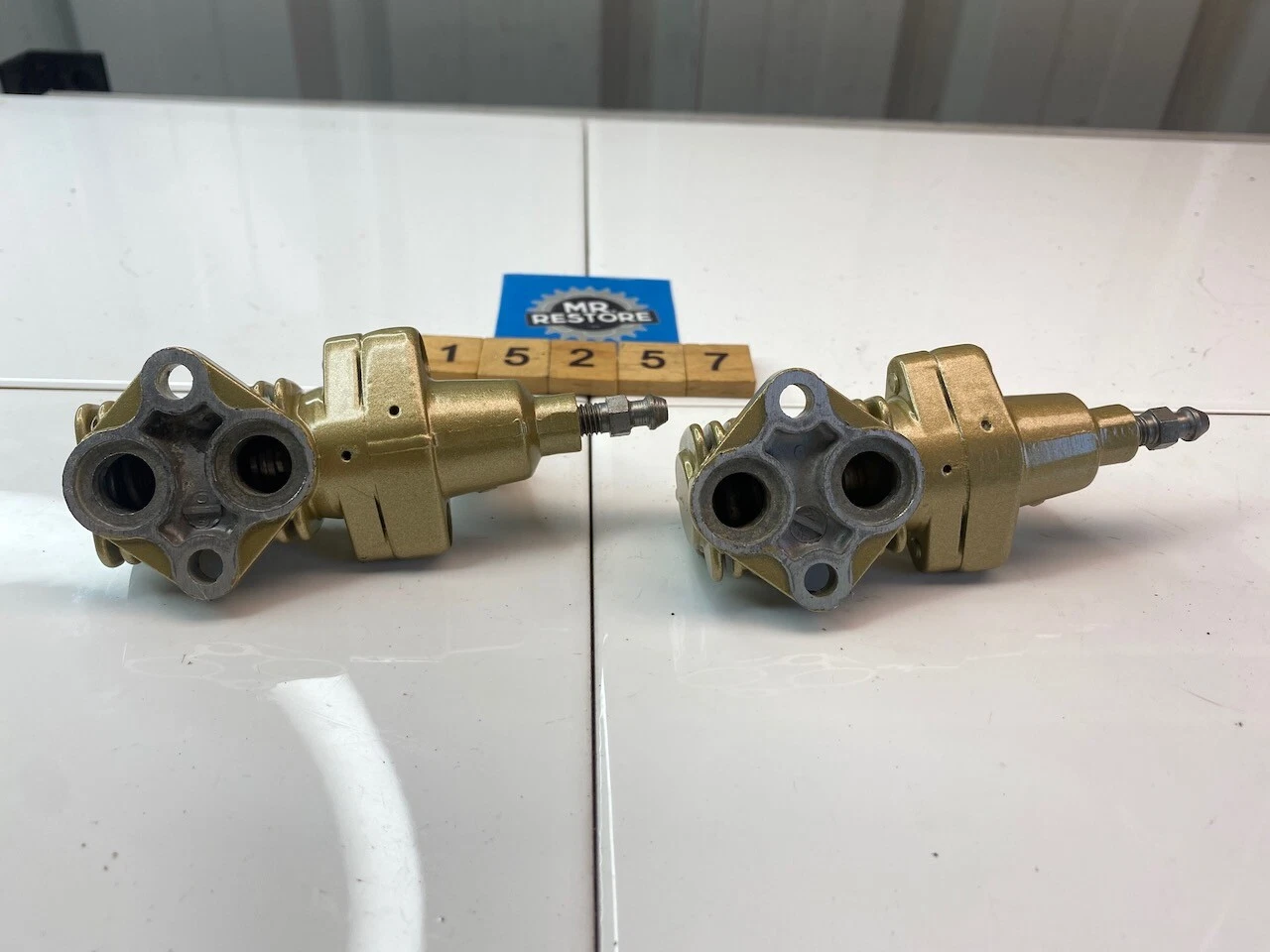
These should totally be serviceable. They fail, and understandably so. There are two weep holes, one on each half of the device. The upper hole is for the part actuated by brake pressure, so brake fluid would come out of that hole. The lower hole is on the the actual valve body working on the fork oil, so that's what should come out of there. I could imagine a scenario where brake fluid could come out of both holes once it eats through the rubber boot, but I think it's pretty obvious to see which component is leaking based on which hole it's coming out of.
I wanted to be sure, so I cleaned and degreased the area and took it for a short drive. It was clearly leaking only from the lower hole, confirming the lower part is where the leak is.
So drained the oil again and removed and separated the valve. These are simple devices, as expected. Just a little piston that moves up and down. Not even sure if it actually seals against a seat, or just adds more restriction as it goes down.
Anyway, theory of operation isn't my main focus, it's the construction. Here's what I found inside:
Step 1: Remove the boot. Mine was rather stuck in there, seemingly due to rust buildup.
I carefully pried it out with a plastic tool. I fully expected it to tear, but it survived. Well, sorta. I can't tell for sure, but it seems like the rubber is supposed to be bonded to this washer. The rust was very much stuck to the rubber and there didn't seem to be a groove or anything to simply hold onto the washer. Whatever the case originally, they're free of each other now, but I think that's generally OK.
Step 2: Remove the circlip. Or snap ring. Or whatever you call it. Mine was rusty, but it came out easily enough. This is what holds the seal assembly in against spring pressure. On a new unit, the seal assembly may or may not pop out at this point as it's only held in by the friction of the O-ring, but mine stayed put.
Step 3: Remove seal and plunger. I got it out by gently pushing it up from within, i.e. sticking a tool inside the upper port and pushing up on the plunger. Piston? Engineering is so pedantic. Anyway, this should push the seal assembly and plunger out together. Then you get this (note: my pic annotations are inaccurate. The larger spring does not push on the nylon part. The large spring pushes against the rubber seat that is still retained in the valve body at this point):
Step 4: Disassemble. The leak opportunities are that upper O-ring and the inner seal that the plunger/piston moves through.
Without original sizes or measurements, I'm really just guessing what my problem is here. I cleaned everything and inspected, measured, reassembled, and it seems like everything should seal. At first I wanted to just replace both parts and be done with it, and I think I got in range with the outer O-ring, but the inner seal is not just a square O-ring. It has to be custom. I measured it at about 3.08mm tall, but only about 2.13mm thick, and that's not just from wear. The plunger OD is about 9.98mm, and the ID of the seal is smaller by about 0.20mm (I think, I didn't write that measurement down). That seems like a good amount of interference, but maybe not enough?
Just to be sure I put everything back together with the original components, refilled the shock, and took it for a test drive. For a while, it seemed like it wasn't leaking anymore, but by the time I got home after an hour on the back roads, I saw some weepage. I think I'm going to start with the O-ring, since I think the one I got will work. I went with a 2.4mm thick 16.6mm ID, but I think 16.3mm ID might be more correct. That more closely matches the original which seems in good health, so its dimensions might still be correct. Still, should be close enough.
If that's not it and it's the inner seal, not sure what to do there. There's an X-ring available that sort of matches the dimensions, except it won't be tall enough to get neatly sandwiched between the seal body and the plastic stop. Does it need to? I don't know, maybe not. There's a bit of a lip in the middle of the seal cavity to retain the original seal, maybe it'll hold onto an X-ring too. We'll see. I know, I could always just get rid of the valves altogether, but I don't want to. This is more fun!