• Required reading for all forum users!!!

    Welcome!
    Register to access the full functionality of the GSResources forum. Until you register and activate your account you will not have full forum access, nor will you be able to post or reply to messages.

    A note to new registrants...
    All new forum registrations must be activated via email before you have full access to the forum.

    A Special Note about Email accounts!
    DO NOT SIGN UP USING hotmail, outlook, gmx, sbcglobal, att, bellsouth or email.com. They delete our forum signup emails.

    A note to old forum members...
    I receive numerous requests from people who can no longer log in because their accounts were deleted. As mentioned in the forum FAQ, user accounts are deleted if you haven't logged in for the past 6 months. If you can't log in, then create a new forum account. If you don't get an error message, then check your email account for an activation message. If you get a message stating that the email address is already in use, then your account still exists so follow the instructions in the forum FAQ for resetting your password.

    Have you forgotten your password or have a new email address? Then read the forum FAQ for details on how to reset it.

    Any email requests for "can't log in anymore" problems or "lost my password" problems will be deleted. Read the forum FAQ and follow the instructions there - that's what we have one for...

  • Returning Visitors

    If you are a returning visitor who never received your confirmation email, then odds are your email provider is blockinig emails from our server. The only thing that can be done to get around this is you will have to try creating another forum account using an email address from another domain.

    If you are a returning visitor to the forum and can't log in using your old forum name and password but used to be able to then chances are your account is deleted. Purges of the databases are done regularly. You will have to create a new forum account and you should be all set.

Use of plugs on tires

  • Thread starter Thread starter Guest
  • Start date Start date
G

Guest

Guest
I'm sure I will get a fair number of comments advising me not to plug a tire. I assure you I will read and take all under advisement. However having ridden on plugged tires for many many miles over the years, I am also comfortable with doing so again.

I have a rear tire on my '81 GS850G with very low mileage that caught a puncture from a steel staple when it had about 1500 miles on it. I wish to plug this puncture to get some additional use from it before springing for a new set.

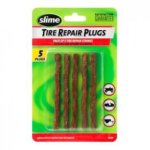
Quaestion is the RED Slime plugs I got do not mention using rubber cement. In past when a mechanic plugged a tire or two for me, he used rubber cement. I see Slime sells kits with and without cement so I am wondering if it is not an extra bit of security to used the cement as well or is that cement for other types of plugs as the kits seem to come with plack plugs and the red ones only come by themselves.

OK, here I am, waiting to hear all sides of the argument.

Thanks, as always for your input.

DH
 
True,
no mention of glue,
the colour is the clue. (I'm a bad poet and I knoet :)

They are not obvious about the difference, but as a guess, I think those red ones are for garden tractors and atvs. Low pressure tires? I'd try them with glue.

ADD Or better, just get some black ones that are definitely for cars
 
Last edited:
The best way to do it is to unmount the tire and patch the hole from the inside, you'd use the same flat type patch and rubber cement used on tubes.
 
True,
no mention of glue,
the colour is the clue. (I'm a bad poet and I knoet :)

They are not obvious about the difference, but as a guess, I think those red ones are for garden tractors and atvs. Low pressure tires? I'd try them with glue.

ADD Or better, just get some black ones that are definitely for cars

There, I learned something. Haven't opened the package so I can return & get black.

Thanks Gorminrider, stay safe!!

DH
 
Oh, thanks! you too! But you know, I begin to wonder why ALL tire plugs aren't red so they are easy to spot on the tire...
 
The best way to do it is to unmount the tire and patch the hole from the inside, you'd use the same flat type patch and rubber cement used on tubes.


Funny you should mention that. :chuncky: I was thinking to put that inner patch in anyway. I had actually started this repair a ways back but ended up getting a new tire installed because my very conservative buddy told me it was safer. That tire has about 800-1000 miles left on it. The front has about 1200-1500 miles to go. The punctured tire really has a lot of meat left & I wanted to use it until the front was retired and then put a new pair on at the same time.

The hole I had started and put a plug in still leaked back then. (The puncture was from a staple I must have picked up from our bee hive building activities so there were really 2 small side by side punctures. I guesses I got the first and thought I picked them both up. I really want to use an inner patch but I want to use a plug to fill in the hole (a 3/16" rod is a tight fit) that remains from that first plug. I plan to try & push a plug in but push it out quick before the glue dries so the inner surface where the patch goes will be completely flat and not interfering with the patch. Then I want to cut the outside remains of the plug off. The patch will be doing all the sealing but the new plug will fill in the hole that is already there. Like a pothole repair.

I am a slug of a rider so really don't stress the tires on the road. If I was one of the speed guys, I'd never do this but as I said I am very comfortable with the patch doing 100% of the sealing and the plug is just to fill in that probably 1/8" hole.

Thanks,

DH
 
There is a brand of plug recommended by Bwringer that you can do from the outside. Not sure it’s a permanent fix though. As stated patching it from the inside would be the better way to do it...
 
I picked up a drywall screw on a trip and bought a plug kit from a local shop. They were the mushroom type, no glue used. I rode for at least another season wit it.
When the tire was replaced, I tried to pull out the plug from the mushroom head on the inside of the tire. It wouldn't come out.
 
Come to think of it, I wonder if the rubber plugs in the kit I bought back in 2014 have a shelf life similar to tires.
 
When I was in Japan riding with the VFR club, I rented a Kawasaki ZXR400R. That thing had at least 5 plugs
in the front tire. I had to haul ass to keep up with these guys and, after a few miles, forgot about the tire

Mad
 
So here is my question to Slime themselves, and the reply:

I have purchased your tire plugs, (deep red color) to patch a nail hole in a tubeless bias-ply motorcycle tire. I asked 2 very experienced MC mechanics if I need to also use the rubber cement along with the plug. One of them says it is not necessary, the other one swears it is and he has always used rubber cement whenever he plugs a tire for nearly 40 years. I know the instructions do not mention using cement but my question is would it do any harm to use rubber cement smeared on the puncture hole & the plug?

And they say:

Thank you for contacting ITW Tire Repair.
It is used as a lubricant. It?s just a preference to use it or not. We have actually stopped putting it in some of our tire plug kits.

So if there was the slightest issue or even no real issue I figure they would put the kybash on the use of cement. Being that it helps as a lubricant, is even more reason to use it as I want to quickly push the plug back out just enough to eliminate any of it sticking inside & interfering with the patch laying flat. BTW the patch kit I got is a Slime product with 3 different sized patches and a tube of cement to boot. Package says it is for radial tires but I doubt it wouldn't work just fine on my MC bias belt tire. Found it at Tractor Supply for $3.19.


images

This kit?
 
I've used lots of plugs on the side of the road due to a job I had. The wheel needn't be taken off. Get your 12volt pump running and go from there. Never without cement. They were fine.

But unless you expect to get a lot of flats, and unless your tire is really new, or lastly you are broke (nothing wrong with saving $) still, if you're flush, why not just GET A NEW TIRE? No more worry, though the practise is useful.
 
proxy-image


It's not hard to see where my low-pressure-ATV-Lawn tractor theory comes from.

Those are the ones I ad just bought but it was suggested the black plugs are intended for on road tires. Either way, I plan to use a patch as the working seal & just fill in the hole in the tire with a plug, though I guess that may not be totally necessary.

DH
 
Nealey Tire Repair kits are the finest sticky string tubeless tire repairs on the planet. Truly next-level stuff, and they work and are installed in a slightly different way than lesser sticky strings.

The Mini kit is that which you seek for motorcycle and car/light truck tires:
https://www.nealeytirerepairkit.com/product-page/copy-of-mini-repair-kit

Most of their business is people repairing enormous truck and heavy equipment tires, so their other kits with much longer strings aren't needed for the likes of us.

They do not require or recommend glue (as the Slime folks said, glue is primarily useful as a lubricant, and is optional), and they are somewhat thinner than other sticky strings. You install them in a different way (READ the instructions!) such that you end up with four thicknesses of string in the hole (they conform to the hole better) and a knot on the inside of the tire so the repair can't pull out.

If it's a simple tread area puncture, I don't really worry about it once repaired.

If it's a large or oddly shaped hole, etc. then you can install multiple plugs until you can escape the situation, but the tire should be replaced immediately.

I have Nealey kits in all our vehicles. The strings remain unchanged and sticky for many years. I'm not 100% sure how old my oldest kit is, but the plastic tube finally fell apart after at least seven or eight years of abuse; the strings and tool were perfectly fine.


I know "plug from the inside later" is the usual recommendation, but high-quality plugs are somewhat hard to find (the Slime brand are common but not very good) and far more failure-prone. I can't say I'm a fan, but YMMV, etc.

That said, it is often a good idea to demount the tire later or at least break one bead and take a look at the inside to make sure there's nothing left inside the tire, the wheel is OK, and the puncture isn't worse than you thought.

But if the whole thing was pretty straightforward (something like a nail or screw that entered fairly straight, made one hole, came out completely, and the tire didn't go completely flat at speed and potentially damage the wheel) I normally don't bother. Plug, pump, go, forget about it.


I carry a small electric "Slime" brand pump, and it's served me well. There are several compact electric pumps on the market that work well.


At all costs, AVOID the "Stop-n-Go" rubber mushroom plug system. They are worse than worthless on motorcycle tires. An absolutely delusional product marketed well.

Also, the CO2 cartridge inflators are pretty useless as well; you need more than you think to get a tire close to rideable, and if you have a leak, well, you're stuck again.


Lastly, I'll repeat my usual advice about tires in general: if any doubt is going to enter your mind at all, spend the small bit of money to replace the tire. Motorcycle tires require absolute mental confidence to function properly. All your mental bandwidth needs to be on your riding, so 100% faith in your tires is mandatory.
 
Last edited:
Nealey Tire Repair kits are the finest sticky string tubeless tire repairs on the planet. Truly next-level stuff, and they work and are installed in a slightly different way than lesser sticky strings.

The Mini kit is that which you seek for motorcycle and car/light truck tires:
https://www.nealeytirerepairkit.com/product-page/copy-of-mini-repair-kit

Most of their business is people repairing enormous truck and heavy equipment tires, so their other kits with much longer strings aren't needed for the likes of us.

They do not require or recommend glue (as the Slime folks said, glue is primarily useful as a lubricant, and is optional), and they are somewhat thinner than other sticky strings. You install them in a different way (READ the instructions!) such that you end up with four thicknesses of string in the hole (they conform to the hole better) and a knot on the inside of the tire so the repair can't pull out.

If it's a simple tread area puncture, I don't really worry about it once repaired.

If it's a large or oddly shaped hole, etc. then you can install multiple plugs until you can escape the situation, but the tire should be replaced immediately.

I have Nealey kits in all our vehicles. The strings remain unchanged and sticky for many years. I'm not 100% sure how old my oldest kit is, but the plastic tube finally fell apart after at least seven or eight years of abuse; the strings and tool were perfectly fine.


I know "plug from the inside later" is the usual recommendation, but high-quality plugs are somewhat hard to find (the Slime brand are common but not very good) and far more failure-prone. I can't say I'm a fan, but YMMV, etc.

That said, it is often a good idea to demount the tire later or at least break one bead and take a look at the inside to make sure there's nothing left inside the tire, the wheel is OK, and the puncture isn't worse than you thought.

But if the whole thing was pretty straightforward (something like a nail or screw that entered fairly straight, made one hole, came out completely, and the tire didn't go completely flat at speed and potentially damage the wheel) I normally don't bother. Plug, pump, go, forget about it.


I carry a small electric "Slime" brand pump, and it's served me well. There are several compact electric pumps on the market that work well.


At all costs, AVOID the "Stop-n-Go" rubber mushroom plug system. They are worse than worthless on motorcycle tires. An absolutely delusional product marketed well.

Also, the CO2 cartridge inflators are pretty useless as well; you need more than you think to get a tire close to rideable, and if you have a leak, well, you're stuck again.


Lastly, I'll repeat my usual advice about tires in general: if any doubt is going to enter your mind at all, spend the small bit of money to replace the tire. Motorcycle tires require absolute mental confidence to function properly. All your mental bandwidth needs to be on your riding, so 100% faith in your tires is mandatory.

I bought one of those on your recommendation for a trip about 10 years ago... I’ve never had to use it but the tube is a bit worse for wear but the threads still seem pliable..... :)
 
Back
Top