
-
Required reading for all forum users!!!
Welcome!
Register to access the full functionality of the GSResources forum. Until you register and activate your account you will not have full forum access, nor will you be able to post or reply to messages.A note to new registrants...
All new forum registrations must be activated via email before you have full access to the forum.A Special Note about Email accounts!
DO NOT SIGN UP USING hotmail, outlook, gmx, sbcglobal, att, bellsouth or email.com. They delete our forum signup emails.A note to old forum members...
I receive numerous requests from people who can no longer log in because their accounts were deleted. As mentioned in the forum FAQ, user accounts are deleted if you haven't logged in for the past 6 months. If you can't log in, then create a new forum account. If you don't get an error message, then check your email account for an activation message. If you get a message stating that the email address is already in use, then your account still exists so follow the instructions in the forum FAQ for resetting your password.Have you forgotten your password or have a new email address? Then read the forum FAQ for details on how to reset it.
Any email requests for "can't log in anymore" problems or "lost my password" problems will be deleted. Read the forum FAQ and follow the instructions there - that's what we have one for...
-
Returning Visitors
If you are a returning visitor who never received your confirmation email, then odds are your email provider is blockinig emails from our server. The only thing that can be done to get around this is you will have to try creating another forum account using an email address from another domain.
If you are a returning visitor to the forum and can't log in using your old forum name and password but used to be able to then chances are your account is deleted. Purges of the databases are done regularly. You will have to create a new forum account and you should be all set.
You should upgrade or use an alternative browser.
Harbor freight brake bleeder
- Thread starter red1100
- Start date


Wrap the gauge in a few layers of clear tape before using it; you're going to drop it at some point, and that stupid gauge is extremely brittle.
Couple of things if you're having trouble bleeding:
1) Air always gets in via the threads around the bleeder. I generally wrap the threads on the bleeder with a few turns of teflon pipe tape to stop this. If you're reasonably neat, there's no danger of teflon bits getting into the system (and even if they do, they're certainly not going to hurt anything in the caliper). Some use grease, but I'd rather not risk contaminating my brake fluid with grease.
2) You have to "bench bleed" the master cylinder if it's been emptied. Pumping with the lever and pulling fluid through with a vacuum pump won't get this air out. If it's already mounted on the bars, remove the lever, find something non-damaging to push with (a wooden dowel, a but driver, a screwdriver wrapped in tape, etc.) and then slowly push the piston alllllllll the way in and back several times. You'll burp those last few bubbles out of that weensy bypass hole at the bottom. If you push too fast, you'll get a jet of brake fluid in the chops.
3) Once you have all the air out, sometimes you have issues with the seals retracting the pads a little too much, so you need more than one pump, or the lever is at the bar before the pads contact the disk. Two common causes of this are crappy aftermarket rebuild kits (the imitation seals in these are dangerous junk; buy OEM only). and crud left in the seal groove. You have to get in there with your best eyeglasses and a sharp pointy tool and get every last bit of gunk out of the corners.
Guest
Guest

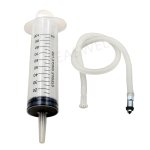
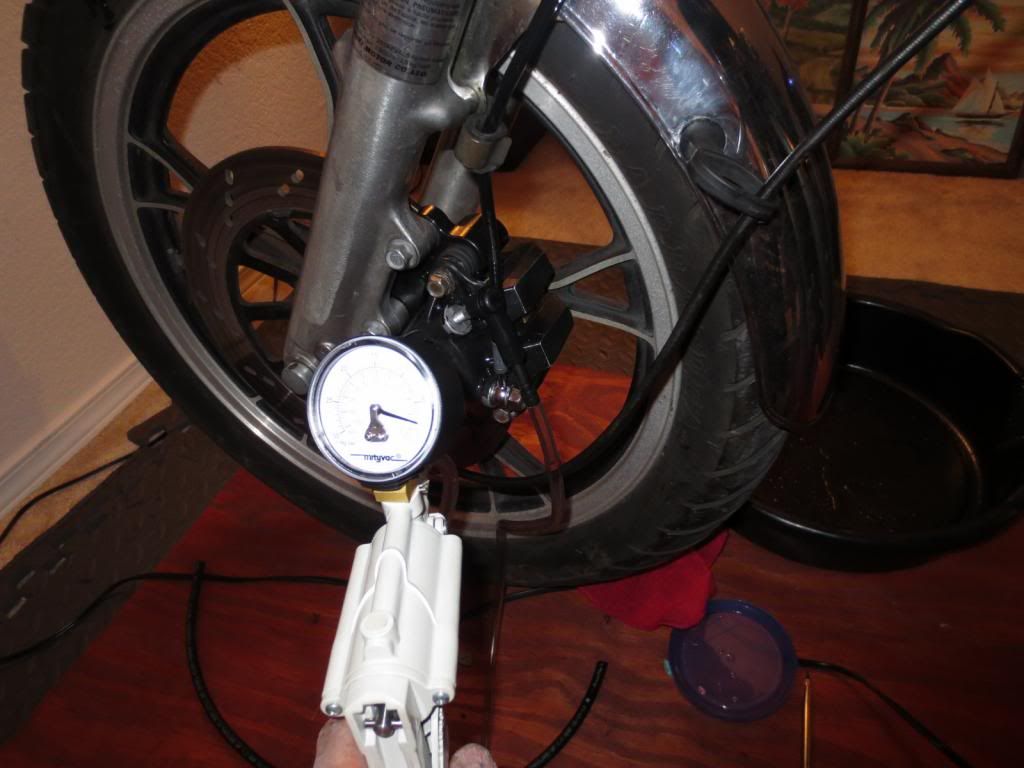
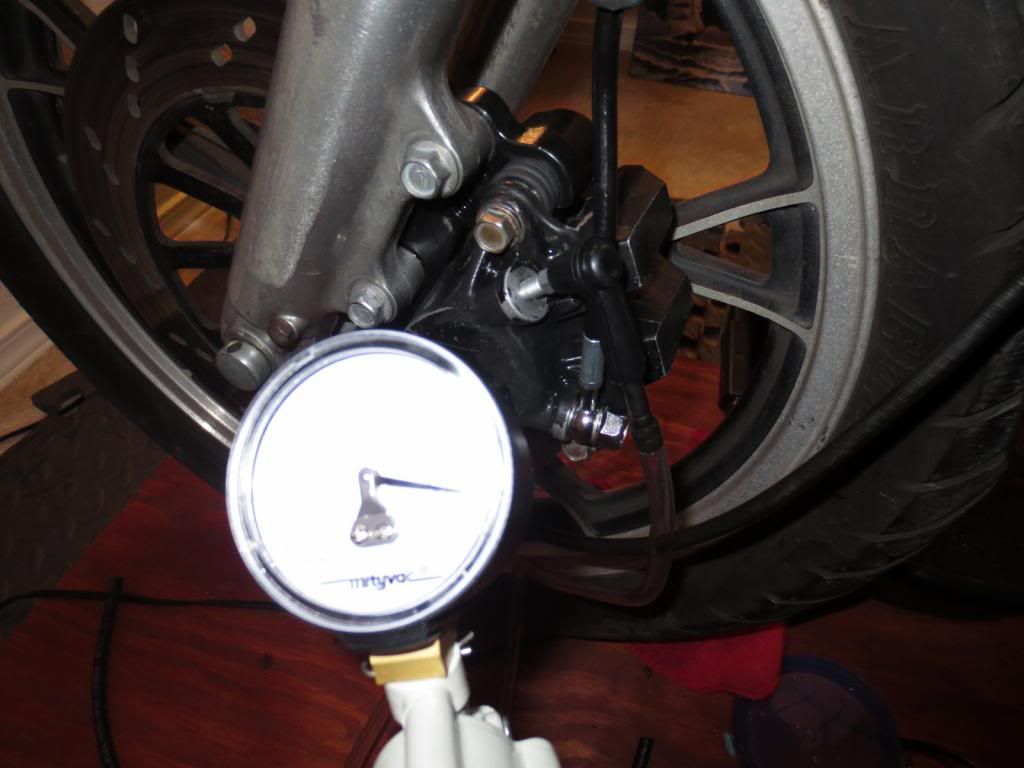
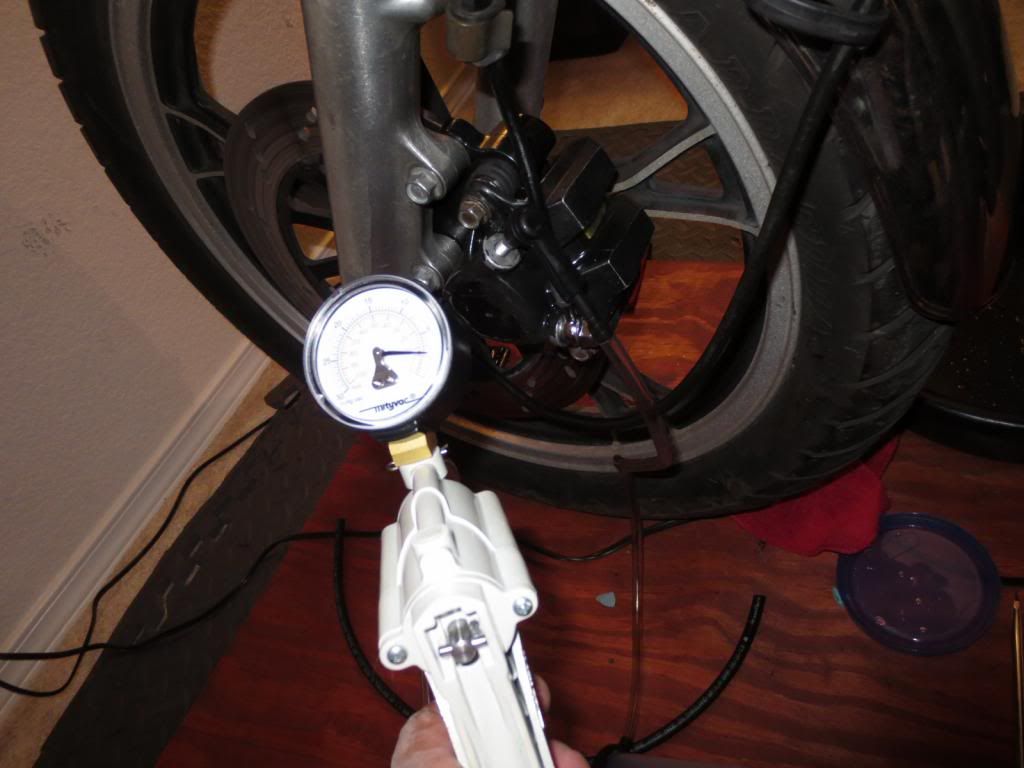

When I was rehabbing my 450 a few years back i came across the "reverse bleeding method" where instead of filling the system with fluid from the master cylinder down you pump it full from the bleeder upward. It worked quite well on the single disk setup and has also been used with success on my dual disk Goldwing. For about $2 worth of parts you can make your own and can't beat it!
View attachment 62512
I don't believe this is a HF special...borrowed it from a friend.
I'll ask him what brand it is...it worked great!
Ed
Well, um, it says Mityvac right there on the gauge...
Long-term, that plastic Mityvac pump is garbage. For one, the plastic is vulnerable to brake fluid; you know, the stuff you're working with... no, brake fluid shouldn't contact the pump, but stuff happens. For another, the seals inside that pump are junk and wear out quickly.
The cheap brass-bodied pump from HF lasts a lot longer. In fact, Harbor Freight does sell that exact crappy plastic Mityvac pump for $45, right next to their superior brass version for $25. They also sell a higher-end "Maddox" brass pump. I don't know anything about that.
None of them will tolerate brake fluid or dirt in the seals; I usually install a large clear plastic fuel filter between the pump and the fluid cup to act as a reservoir, keep dirt out (dirt's usually not a problem with brake systems, but it can be an issue with testing vacuum actuators and such), and to give me a little extra warning if fluid is starting to get slurped into the pump, like if the cup tips over. As it usually does...
That pneumatic brake bleeding kit from HF looks very interesting too and the reviews are great -- I'll probably pick one up next time I'm doing brake stuff.
https://www.harborfreight.com/brake-fluid-bleeder-92924.html
I've never been impressed with reverse bleeding compared to vacuum bleeding. But do whatever you're comfortable with, I guess.
One very important distinction is that reverse bleeding should ONLY be done with a new or newly rebuilt system. NEVER reverse bleed to do a flush on a system that's been in use very long; otherwise you're sending whatever is happening in the calipers up to the far more sensitive master cylinder.
On most (but not all) newer ABS bikes (check the manual), conventional bleeding works fine for flushing, but folks have had issues trying reverse bleeding on systems that haven't been flushed recently; even very mild gunk from the calipers can play havoc with ABS components, and sometimes there are check valves and whatnot that don't take kindly to or allow reverse flow.

Maddevill
Forum Mentor
Well, um, it says Mityvac right there on the gauge...
Long-term, that plastic Mityvac pump is garbage. For one, the plastic is vulnerable to brake fluid; you know, the stuff you're working with... no, brake fluid shouldn't contact the pump, but stuff happens. For another, the seals inside that pump are junk and wear out quickly.
The cheap brass-bodied pump from HF lasts a lot longer. In fact, Harbor Freight does sell that exact crappy plastic Mityvac pump for $45, right next to their superior brass version for $25. They also sell a higher-end "Maddox" brass pump. I don't know anything about that.
None of them will tolerate brake fluid or dirt in the seals; I usually install a large clear plastic fuel filter between the pump and the fluid cup to act as a reservoir, keep dirt out (dirt's usually not a problem with brake systems, but it can be an issue with testing vacuum actuators and such), and to give me a little extra warning if fluid is starting to get slurped into the pump, like if the cup tips over. As it usually does...
That pneumatic brake bleeding kit from HF looks very interesting too and the reviews are great -- I'll probably pick one up next time I'm doing brake stuff.
https://www.harborfreight.com/brake-fluid-bleeder-92924.html
I've never been impressed with reverse bleeding compared to vacuum bleeding. But do whatever you're comfortable with, I guess.
One very important distinction is that reverse bleeding should ONLY be done with a new or newly rebuilt system. NEVER reverse bleed to do a flush on a system that's been in use very long; otherwise you're sending whatever is happening in the calipers up to the far more sensitive master cylinder.
On most (but not all) newer ABS bikes (check the manual), conventional bleeding works fine for flushing, but folks have had issues trying reverse bleeding on systems that haven't been flushed recently; even very mild gunk from the calipers can play havoc with ABS components, and sometimes there are check valves and whatnot that don't take kindly to or allow reverse flow.
That pneumatic bleeder is what I have. It's outstanding.
Mad

Well, um, it says Mityvac right there on the gauge...
Long-term, that plastic Mityvac pump is garbage. For one, the plastic is vulnerable to brake fluid; you know, the stuff you're working with... no, brake fluid shouldn't contact the pump, but stuff happens. For another, the seals inside that pump are junk and wear out quickly.
The cheap brass-bodied pump from HF lasts a lot longer. In fact, Harbor Freight does sell that exact crappy plastic Mityvac pump for $45, right next to their superior brass version for $25. They also sell a higher-end "Maddox" brass pump. I don't know anything about that.
None of them will tolerate brake fluid or dirt in the seals; I usually install a large clear plastic fuel filter between the pump and the fluid cup to act as a reservoir, keep dirt out (dirt's usually not a problem with brake systems, but it can be an issue with testing vacuum actuators and such), and to give me a little extra warning if fluid is starting to get slurped into the pump, like if the cup tips over. As it usually does...
That pneumatic brake bleeding kit from HF looks very interesting too and the reviews are great -- I'll probably pick one up next time I'm doing brake stuff.
https://www.harborfreight.com/brake-fluid-bleeder-92924.html
I've never been impressed with reverse bleeding compared to vacuum bleeding. But do whatever you're comfortable with, I guess.
One very important distinction is that reverse bleeding should ONLY be done with a new or newly rebuilt system. NEVER reverse bleed to do a flush on a system that's been in use very long; otherwise you're sending whatever is happening in the calipers up to the far more sensitive master cylinder.
On most (but not all) newer ABS bikes (check the manual), conventional bleeding works fine for flushing, but folks have had issues trying reverse bleeding on systems that haven't been flushed recently; even very mild gunk from the calipers can play havoc with ABS components, and sometimes there are check valves and whatnot that don't take kindly to or allow reverse flow.
Ahhh, heck, I don't remember the name brand of it...even though it was marked on the white gauge, I couldn't make it out.
I've only ever used one of those once so the name had escaped me.
The guy I borrowed it from is a Boeing Engineer who helped me do the valve clearance as well.
The info you provided is a good advice and should help anyone taking on this task.
Ed
****


I think a bonus with those things is that if you can get continuous flow you should be able to flush without needing to trigger the ABS pump. Some newer bikes & cars need you to trigger the pump in order to bleed it through otherwise....

dpep
Administrator
Is it this one:
https://www.harborfreight.com/brake-fluid-bleeder-92924.html
or this one:
https://www.harborfreight.com/brake-bleeder-and-vacuum-pump-kit-63391.html
...
Fluid raises holly hellll on the pump oring.